
Automating a business tool
Trainee groups, simulated in one click
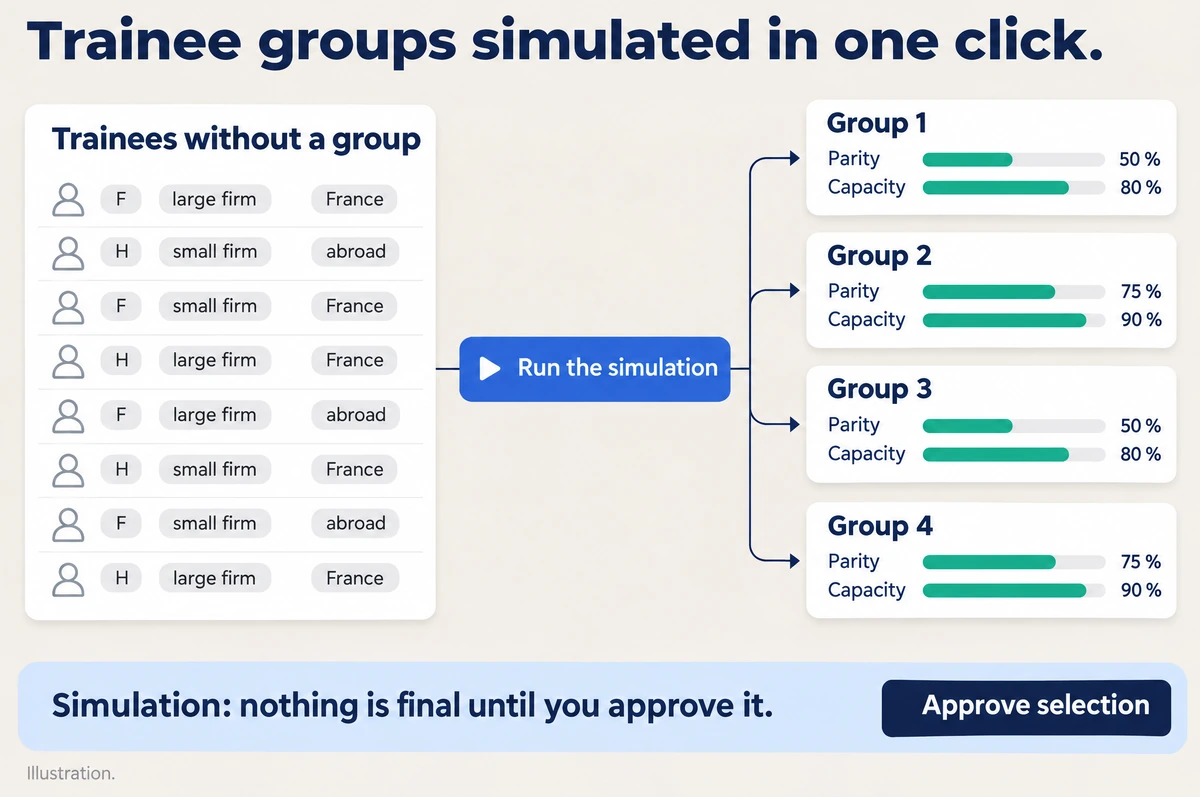
Trainee accountants at the Paris Île-de-France Order of Chartered Accountants are divided into trainee groups. The Order's teams used to put these groups together by hand, one trainee at a time. A module in the Espace Pro (the Order's portal) now proposes the allocation: the teams simulate it, review it and approve it.
In service
1 click to simulate how the groups are split
- Before
- Trainee groups put together by hand, one trainee at a time.
- After
- A module that simulates the allocation in one click. The administrator reviews and approves.
By the numbers
- 1 click to simulate the allocation
- 3 balancing rules, plus each group's capacity
- 1 week of development
- April 20, 2026 go-live
The starting point
- Each trainee group has a number and a training supervisor.
- The rules are strict: as many women as men, as many trainees from large firms as from smaller ones, plus other criteria.
- Each trainee was assigned to a group individually. According to our team, the process took several days.
- An audit of the Trainee module recommended automating group creation and keeping human intervention for special cases.
What the module does
- It automatically allocates trainees who do not yet have a group.
- It applies three balancing rules: gender parity, the proportion of trainees from large firms, and location in France or abroad.
- It respects each group's maximum capacity.
- The list of large firms is managed from the interface: the teams add or remove a firm without any development work.
How it works for an administrator
- They open the allocation panel in their management area.
- They run a simulation. In one click, they see the proposed allocation and judge whether the groups are right.
- Assignments only become final once approved.
- They can approve the whole proposal, or only part of it.
Guardrails
- The decision stays human: the algorithm proposes, the administrator approves.
- Several administrators can work at the same time without creating conflicts.
- Before approval, the module checks that no trainee has been assigned by hand since the simulation.
Implementation
- The module was developed in one week and went live on April 20, 2026.
- That speed comes from our knowledge of the platform: we already knew where to find every piece of data.
- The allocation logic sits on the server side, and the code is split into modules.
- The platform runs on Angular (a web interface framework) and Firebase (Google's data services), among others.
On the same platform
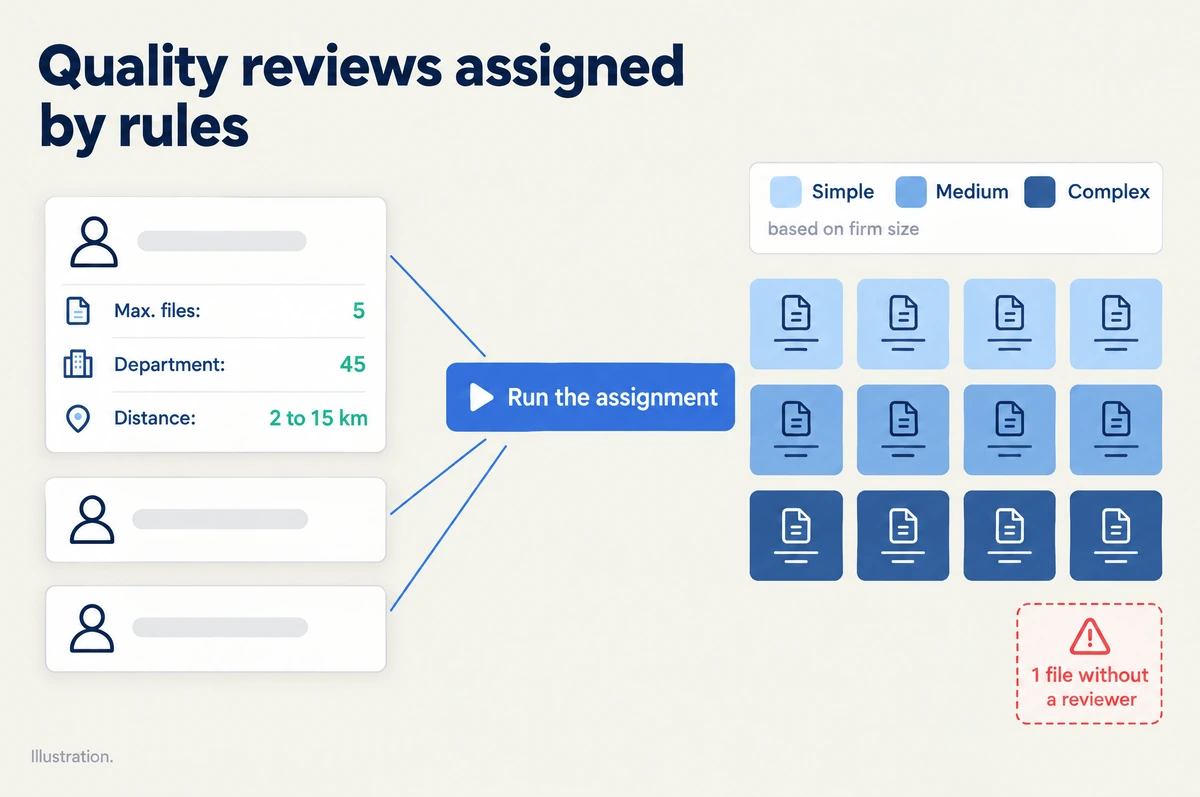
- Quality reviews: a sister module assigns the accountants under review to reviewers, based on distance, the reviewer's level and the complexity of the file. According to our team, assigning around 500 accountants to roughly a hundred reviewers takes one minute.
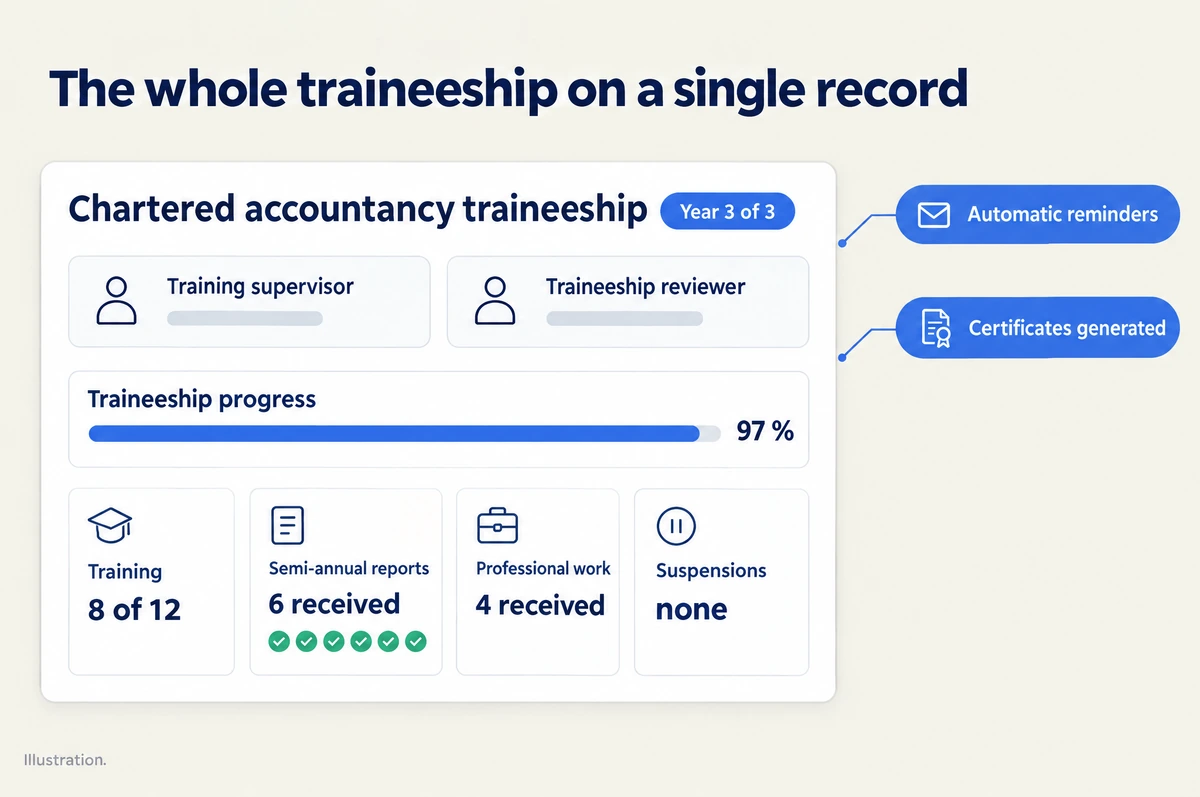
- Training completion certificate: the whole process is now online, from the trainee's request to the generated certificate, via the summary sheet, the supervisor's comments and the electronic signature.
- According to our team, a job that took a week takes five minutes when everything goes smoothly.
Technologies
- Angular
- Firebase