
Preparing payroll
Payroll prepared every day, reviewed by HR
Six locations, hundreds of short-term contracts, and payroll items arriving by email, spreadsheet and form. Camélia, our payroll agent, gathers everything, reads the documents and prepares each item. The HR team reviews, decides and enters the data. The agent has been in service since July 2026.
Lease Caméliafrom $1,500 a month, 24 months
In service
93% of contract requests ready to generate as-is
- Before
- Payroll items scattered across five channels, to be cross-checked and re-entered by hand.
- After
- A payroll agent in service since July 2026, hosted in France. It gathers, reads and prepares. The HR team reviews, decides and enters the data.
By the numbers
- 6 locations covered
- 807 employee records kept up to date (August 2026)
- 93% of the 412 contract requests for 2026 ready to generate as-is (September 2026)
- 218 of 404 contract requests for one month or less, spotted by reading the spreadsheets
- 5 min between checks of the HR inbox
- 453 automated tests passing with every release (September 2026)
Before: five sources, lots of manual re-entry
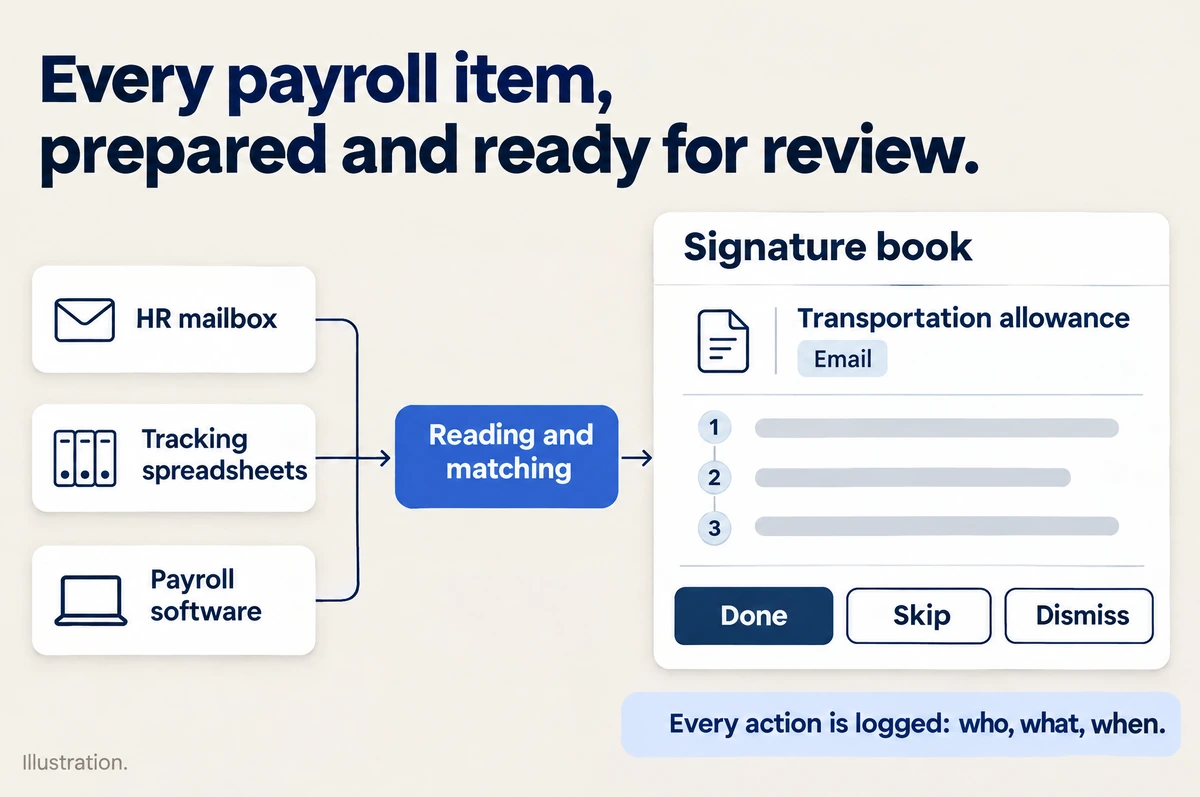
- Variable payroll items (hours, bonuses, absences, transportation) came in through five channels: the HR mailbox, SharePoint spreadsheets (Microsoft's shared file space), forms, the PayFit payroll software and the assignment-tracking software.
- A single email could carry several items. Supporting documents arrived as scans and photos.
- The pay period runs from the 24th to the 23rd, with about twelve days to produce the payroll.
- An employment contract had eight details to fill in by hand, across fourteen fields.
What the agent does, every day
- It checks the HR inbox every 5 minutes, the tracking spreadsheets every 30 minutes and the payroll software every 6 hours.
- It reads attachments, including scans and photos, with a European OCR (automatic document reading) engine.
- It matches each item to the right employee, spots duplicates and flags anything it isn't sure about.
- It applies the company's payroll rules, written out one by one and viewable on screen.
The everyday screen: the approval queue
- Each one becomes an action item, with its original source and a step-by-step data entry guide.
- A badge shows whether the item seems to be in the payroll software already.
- The team marks the item as done, dismisses it with a reason, or asks the agent to clarify an ambiguous case.
- Every step is logged: who, what, when.
Contracts, straight from the spreadsheets
- Camélia reads the requests in each location's spreadsheets, by column header.
- She pulls the employee's personal details from the payroll software, without storing them, and fills out the company's templates: contrat d'usage (a French fixed-term contract used in certain industries), fixed-term (CDD) and permanent (CDI) contracts, transcribed word for word.
- An inconsistent date, a missing legal reason for the fixed-term contract, an unreadable number of hours: the contract isn't generated, and the screen says why.
- Reading more than 400 requests brought out discrepancies that a single contract does not show: the agent flags them, the HR team decides.
- HR reviews, then generates. Nothing goes out without their say-so.
Around payroll
- When a contract is generated, the onboarding documents go to the employee: supplemental health insurance, meal vouchers, photo release, workplace rules.
- Replies come back in a dated summary, and signed documents are filed in the employee's record.
- Hours from the assignment-tracking software become import files for the payroll software, checked line by line.
- The tool also tracks contract amendments, residence permits, occupational health appointments and length of service.
What the agent does not do
- It doesn't run payroll or issue any pay stubs.
- It writes nothing into the payroll software: importing and data entry remain human tasks.
- It doesn't evaluate anyone: no scores, no rankings.
- A disputed case remains the employer's decision.
HR data, treated as such
- The application is hosted in France by Scaleway, on a dedicated server, with a named account for each person. The database is backed up every day, with an integrity check.
- The AI engine is European (Mistral). No employee data leaves Europe, and none is used to train a model.
- For a sick leave note, the agent keeps the employee's identity, the dates and the type of leave. The diagnosis and the medical reason are removed before saving. The original document stays attached, with restricted access.
- The framework includes a data-processing agreement (article 28 of the GDPR), an entry in the record of processing activities and a note for the CSE (the French works council).
Technologies
- Node.js
- React
- SQLite
- Docker
- Mistral
- Microsoft Graph
- Scaleway