
Online shareholder meetings
Online shareholder meetings, from financial statements to filing
Every year, a company must approve its accounts and file them with the commercial court registry. BeeLegal wants to make this easy for a small business owner. We designed and built the platform: a guided seven-step process, from the company to the filing.
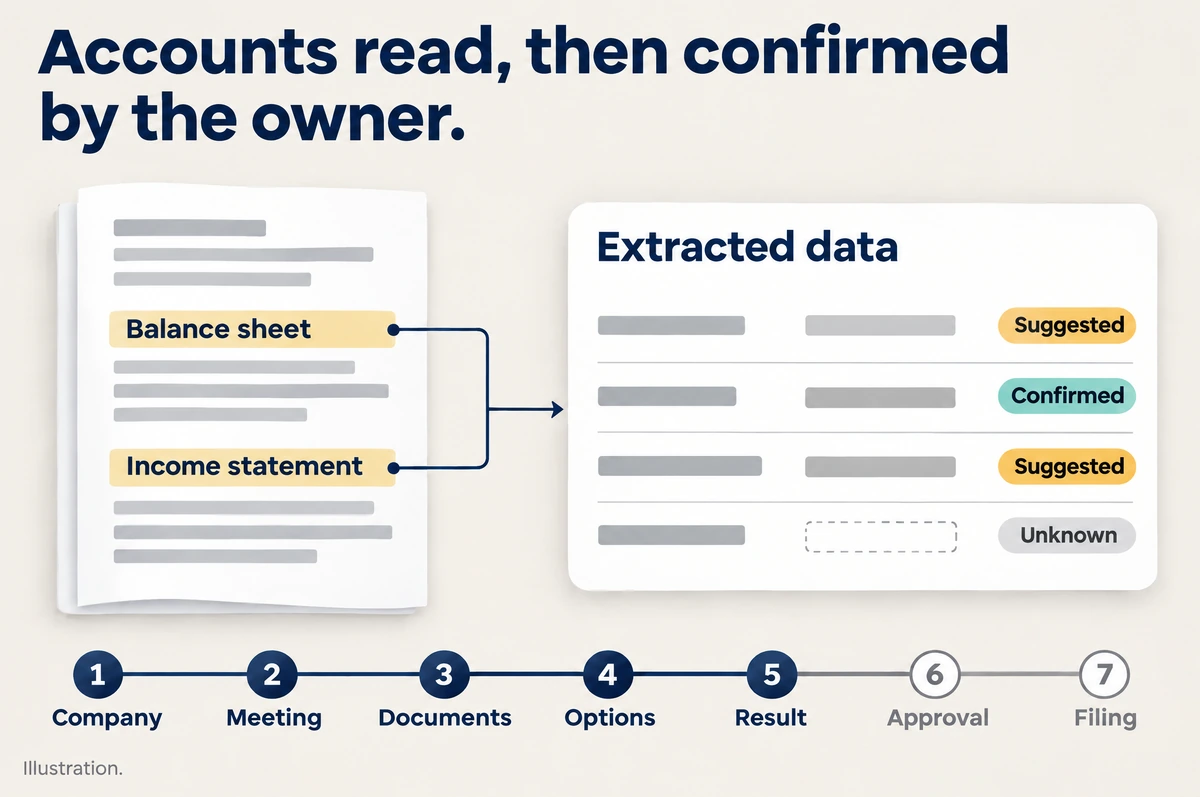
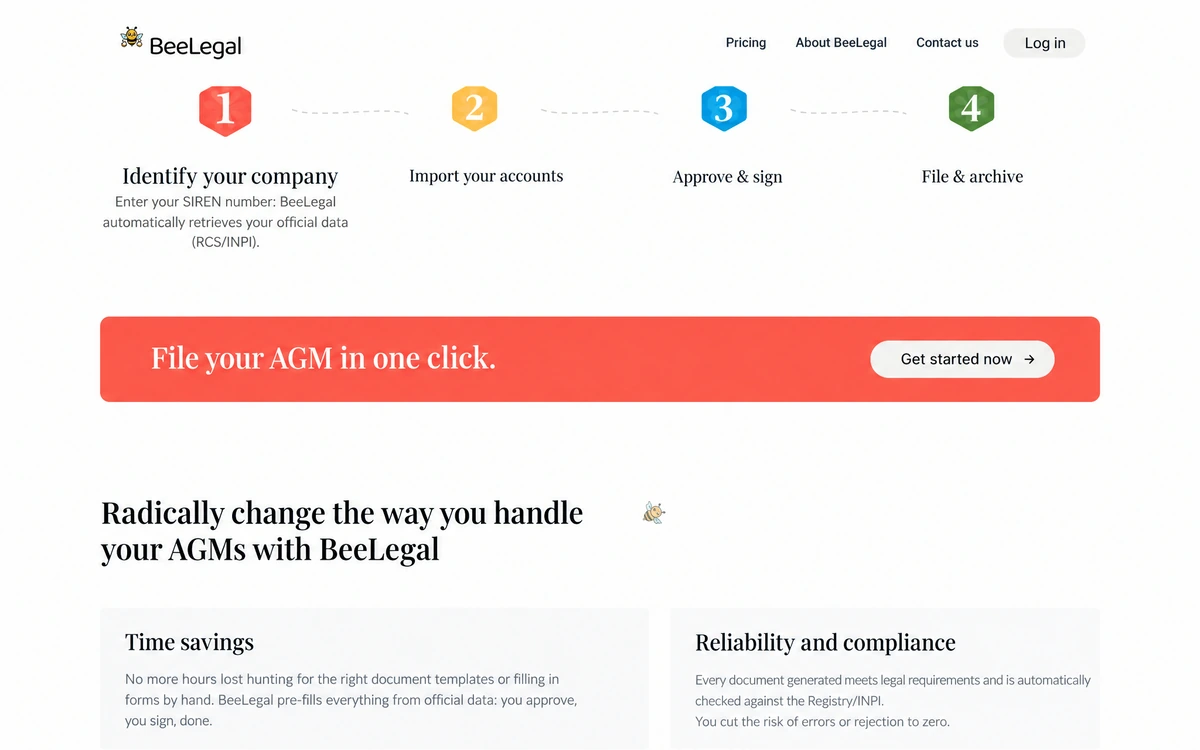
7 steps, from company details to filing
- Before
- Shareholder meeting paperwork produced by hand, document by document.
- After
- Accounts read by AI then confirmed, documents generated, e-signature and online filing in the same process.
By the numbers
- 7 steps, from company details to filing
- 5 legal forms supported
- 6 types of generated documents
- 1,662,464 annual financial statement filings recorded by French commercial court registries in 2025 (Infogreffe)
The need
- In 2025, French commercial court registries recorded 1,662,464 annual financial statement filings (source: Infogreffe).
- Without an accounting department, a business owner has to produce the documents by hand, one by one, and re-enter the numbers.
- The goal: a short, guided process that's easy to follow and legally sound for the situations it covers.
The process, from company details to filing
- The company: official data is pulled from public registries, and the rest is filled in as of the fiscal year-end.
- The meeting: date, time, place and attendees.
- The documents: upload, reading and confirmation of the figures.
- The decisions: file options, allocation of profit or loss, overall review.
- The final steps: generation, payment, signing and filing, with each status tracked.
Reading the financial statements, without deciding for the owner
- The business owner uploads their balance sheet, income statement or full financial statements, from a computer, or from a phone using a QR code (a code to scan).
- An OCR (automatic document reading) engine from Mistral, a French AI company, turns the pages into text. The balance sheet and the income statement are located, then separated.
- Each extracted value comes with its source and a confidence level.
- The owner reviews, corrects and confirms. A value that can't be found stays unknown: it never becomes zero.
Documents generated without AI
- Once the data is confirmed, the documents come out of templates, by calculation and not by automated writing.
- Minutes, resolution on the allocation of profit or loss, attendance sheet, special report, confidentiality declarations for the financial statements, certificate of conformity: each tailored to the company's legal form and situation.
- Five French legal forms are supported: SAS and SASU (simplified joint-stock companies), SARL and EURL (limited liability companies) and SCI (real estate holding companies). No file can be opened for any other form.
Signing, payment and filing
- E-signature goes through Yousign (a signature provider), with a code sent by email.
- Payment goes through Stripe (a payment provider).
- Filing goes through the API (connection interface) of the INPI's one-stop shop for corporate filings, with a qualified electronic seal on the filing summary.
- If the filing is rejected, the file goes back for correction. Nothing is refiled automatically.
- These connections are being tested or validated before launch.
Under the hood
- A platform split into microservices (small independent services): sign-in, companies, workflow, documents, signing, filing, payment, analysis.
- Next.js and React (interface libraries) on screen, Node.js (server-side engine) and Python (programming language) for the services, MongoDB (database) and RabbitMQ (message queue) for long-running jobs.
- Hosted by Scaleway (a French hosting provider) in Paris, on Kubernetes (container orchestrator), with a separate environment for production.
Where the project stands
- The platform runs in a private environment, used by the client with her own data.
- The public website is live, with a waitlist.
- Full acceptance testing and a first real filing come before the public launch.
Technologies
- Next.js
- React
- Node.js
- Python
- MongoDB
- RabbitMQ
- Mistral
- Scaleway
- Kubernetes