
In service Lease from $1,500 a month ≈ 50 hours saved a month
Public contracts are open to everyone, but they reward those who have the time.
- Public bids
- Complete file
- You submit
Lease this agent Book a meeting
Estimate for a company that responds to 4 bids a month
Agent identity cardFront

- Agent name
- MAGNOLIA
- Role
- Tender agent
- Office
- No. 2 · Business development
- Works for
- Your sales team
- Built by
- Rodium, Paris
- Distinctive feature
- Never makes up a document
No. AGT-002-AO · Rodium agent library
Skills
- Monitoring
- Analysis
- Writing
- Review panel
Authorizations
- Find and analyse noticesAllowed
- Write the bid in your brandingAllowed
- Decide to bidReserved for your team
- Sign and submitReserved for your team
Motto I prepare, you decide.
Agent identity cardBack
What she will never do
- Decide to bid for you
- Sign
- Submit the bid
- Make up a document or a reference
Who does what
- Monitoring
- Daily, notices scored
- Writing
- In your branding
- Review
- Three examiners
- Decision and signature
- You
Reminders seven days before, two days before and on the day. A document is missing: you are asked.
Magnolia in four numbers
≈ 50 h
hours saved a month
Estimate for a company that responds to 4 bids a month
2 of 5
steps stay with you
Decide · Sign and submit
5
sources read for you
Bid notices · Bid documents · Your documents · Your references · Awarded contracts
$1,500
a month, leased over 24 months
The demo
See Magnolia at work
The guided tour in 3 minutes, in French: a public tender from notice to submission, what Magnolia prepares and what you decide.
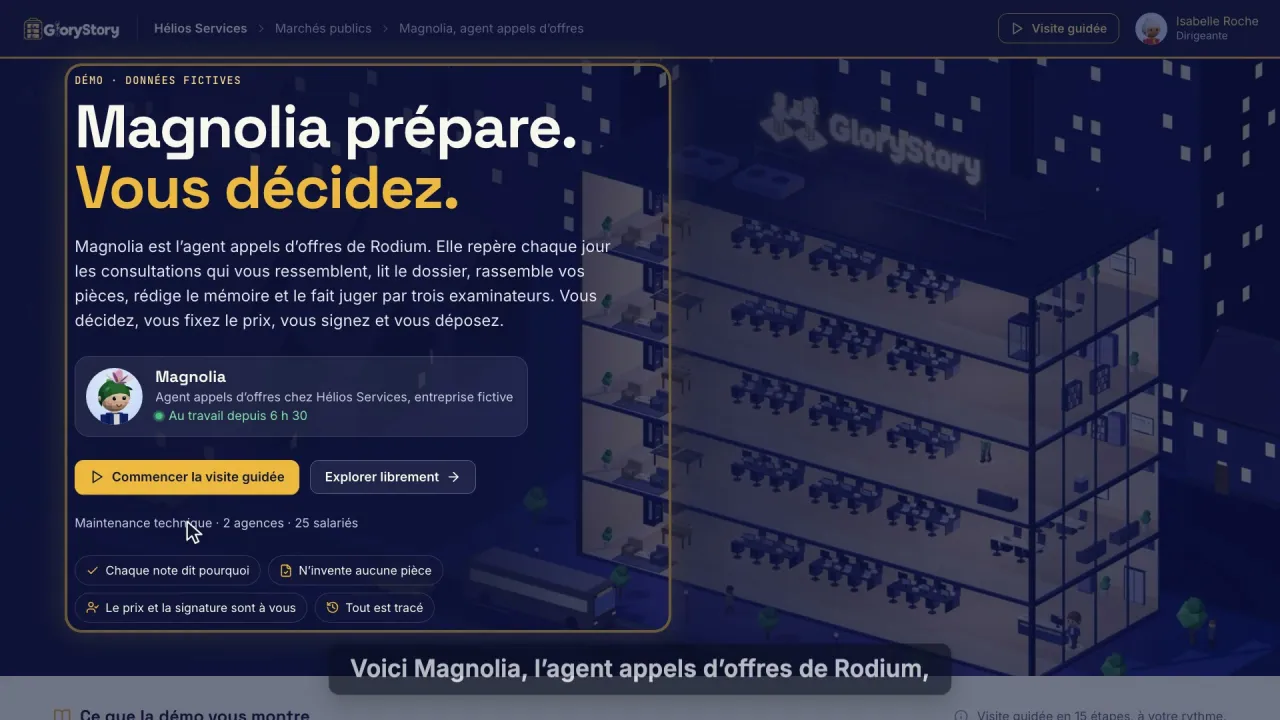 Watch the video
 Try the demo (in French)
Read the transcript (in French)
Voici Magnolia, l'agent appels d'offres de Rodium, ici chez Hélios Services, une entreprise fictive. Sa règle : elle prépare, vous décidez. Cette nuit, sa veille a parcouru 312 avis de marchés publics. Quatre consultations sont à trancher à la réunion de 10 h.
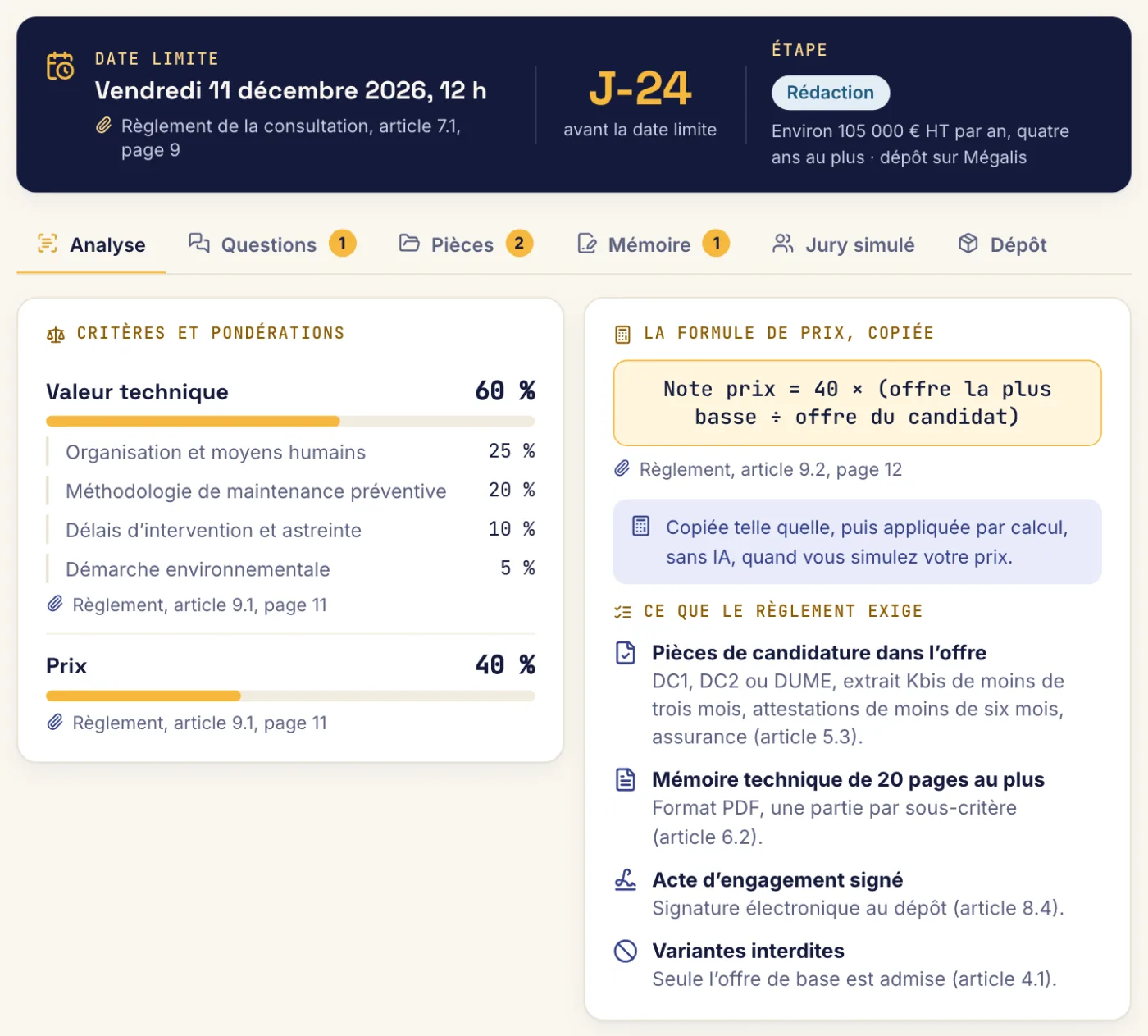
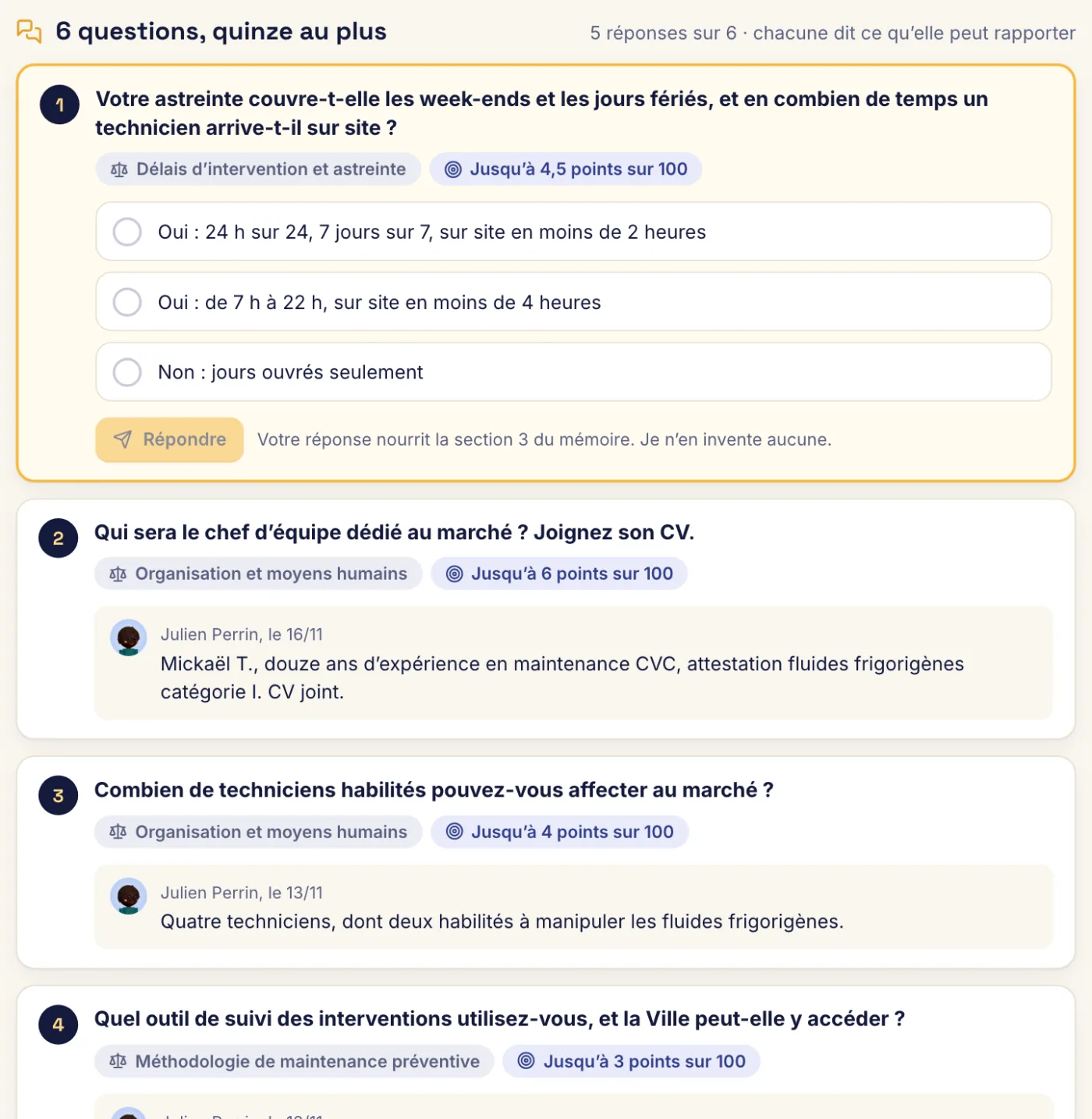
Suivons une consultation de la Ville de Port-Lune. Magnolia la repère ; vous décidez d'y répondre. Elle prépare l'offre, puis la fait juger. Le prix, la signature et le dépôt restent à vous. 17 sur 20 : votre métier, votre zone, votre cible de montant. Signalée dès 13, forte dès 16. La veille se fait sans IA. Répondre, Répondre si…, Ne pas répondre, À décider : Magnolia propose, vous décidez à la réunion du mardi. Date limite, critères, pondérations, formule de prix : chaque information vient d'un article du règlement, avec sa page. Ses questions, quinze au plus, disent ce qu'elles peuvent rapporter : jusqu'à 4,5 points sur 100 pour l'astreinte. Votre réponse nourrit le mémoire.
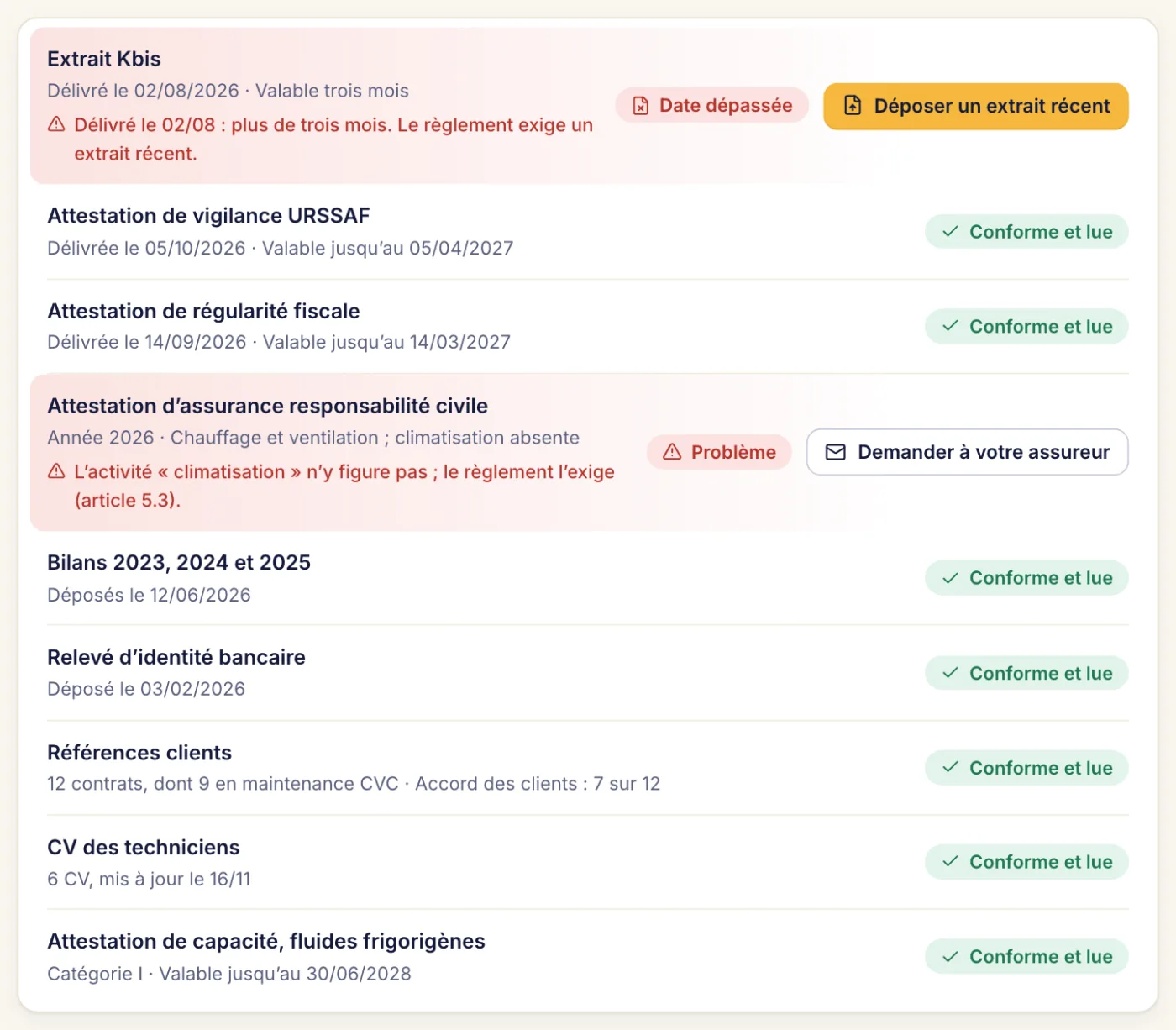
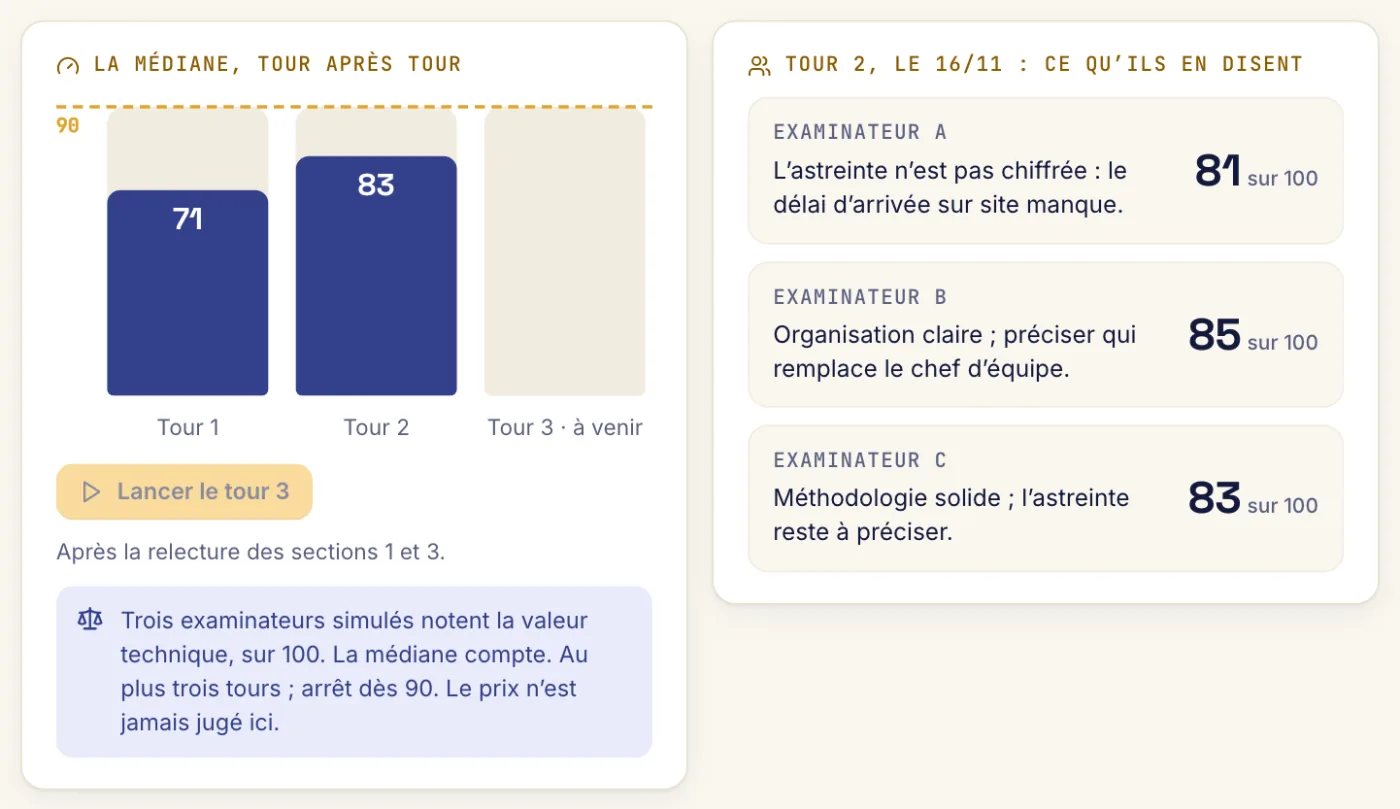
Votre Kbis a plus de trois mois, l'assurance oublie la climatisation : Magnolia vous les demande, elle ne les fabrique pas. Le mémoire suit la grille de notation, une section par sous-critère. Vous relisez chacune avant le jury. Trois examinateurs simulés notent la valeur technique. La médiane compte : au plus trois tours, arrêt à 90 sur 100. Le prix, lui, n'est pas jugé. Avant le dépôt, dix contrôles. Un seul contrôle bloquant suffit : l'offre ne part pas. Le pli est prêt trois jours ouvrés avant la date limite. Vous fixez le prix. Magnolia calcule la note prix avec la formule du règlement, sans IA. Puis vous signez et vous déposez.
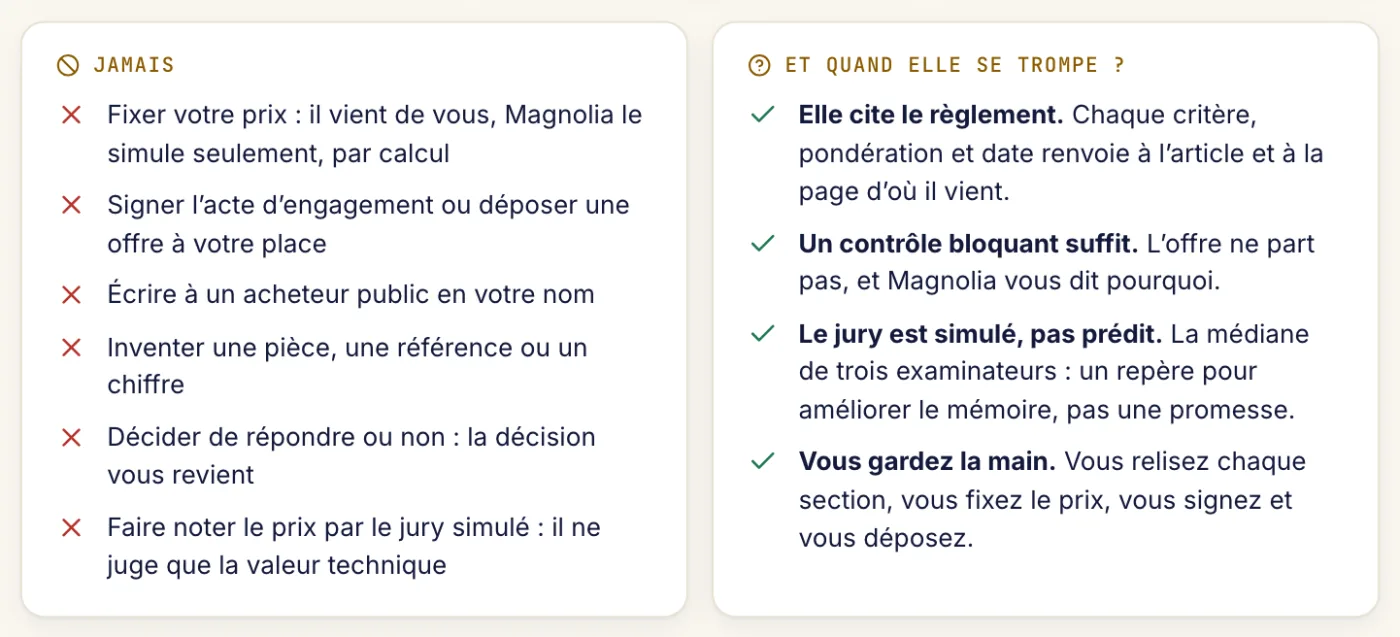
Fixer un prix, signer, déposer, écrire à un acheteur, inventer une pièce : jamais. Tout est tracé : chaque geste est daté, avec son auteur, sa pièce et l'IA utilisée. En résumé : Magnolia repère et prépare ; vous décidez, vous fixez le prix et vous signez. Parlons de votre cas avec Rodium.
Her screens, one by one



The flow
What Magnolia reads, and what comes out
Your sources
- Bid noticesspotted every morning
- Bid documentsinstructions to bidders, specifications
- Your documentsKbis, certificates, balance sheets
- Your referencespast projects, team resumes
- Awarded contractsprices buyers accepted
 Magnoliaanalyzes, writes, gets it scored
What comes out
- Reasoned recommendationbid, bid if, or no bid
- Qualificationsforms filled out, certificates up to date
- Proposaltechnical proposal written criterion by criterion
- Panel scorepoints lost, fixes made
- Questionswhat's missing, for you to answer
Nothing is sent to the buyer on your behalf.
The problem
Answering a public bid is a second job
Reading the bid rules, gathering the documents, writing for each buyer: a proposal takes days of work. It's not a question of skill. The companies that win have someone whose job it is.
We saw it the day before the deadline.
The right contract goes unnoticed
Notices come out every day on several platforms. The one that suited you is seen too late, or never.
It was in the bid rules.
The rules of the game are buried
Criteria, the weight of each one, the price formula, required documents: it's all in the instructions to bidders. One oversight is enough to get the proposal thrown out.
The same Kbis, one more time.
Documents get copied over and over
Certificates, headcount, references: every bid asks for them again. A fact copied wrong, like a person who has left listed on the team, costs points.
Nobody had time to proofread it.
The proposal goes out without a second pair of eyes
The team submits whatever it had time to write. Points are lost on criteria nobody checked.
TodayBy hand
- You browse the platforms when you have a moment.
- You skim the bid rules the day before the deadline.
- You copy the Kbis (company registration), certificates and references from one bid to the next.
- You write the technical proposal, the part of the bid that answers the criteria, without following the buyer's scoring grid.
- You submit without knowing where the proposal loses points.
With MagnoliaThe decision stays yours
- The notices that fit you are spotted and scored every morning.
- The bid rules are read before any writing starts, and Magnolia gives her recommendation in one sentence.
- Your documents are uploaded once, then checked for every bid.
- The technical proposal answers each criterion, in the order of the buyer's scoring grid.
- A simulated panel scores the proposal before the buyer does, and Magnolia makes corrections.
How it works
One bid in five steps, two of them yours
Spotting, preparing and getting it scored: that's the job of Magnolia and the agents in her office. Deciding to bid, then signing and submitting: that's yours, because a bid commits your company.
- 01Magnolia
Spot
Every morning, new notices are read and scored based on your line of work. Dahlia, the monitoring agent in the same office, takes care of it.
- 02Your team
Decide
You choose in one click whether to bid or not. Magnolia gives you her recommendation, with the reason.
- 03Magnolia
Prepare
She reads the bid rules, writes the qualifications and the proposal, and fills out the buyer's forms.
- 04Magnolia
Score
Three simulated reviewers score the proposal using the buyer's scoring grid. Magnolia makes corrections, then they score it again.
- 05Your team
Sign and submit
You review, sign and submit the complete package on the buyer's platform.
What Magnolia connects to
- Notices and platforms
- BOAMP
- TED
- PLACE
- Maximilien
- Mégalis
- Contract prices
- French public procurement data (DECP)
- Your documents
- Word
- Excel
- Microsoft 365
- Google Workspace
The workstreams
Three workstreams, one file
From notice to proposal ready to submit, everything is tracked in an online office in your name. Every version, every score and every check is timestamped there.
Analysis
Before writing a single line, Magnolia reads the bid rules: value, criteria and the weight of each one, price formula, required documents, mandatory site visit. She sums it up in one sentence: bid, bid if, or don't bid.
In practice: The buyer's formula flattens price differences. Magnolia shows it: a steep price cut would earn almost no points, and the technical proposal counts for more.
Writing
She delivers the complete qualifications and proposal, in your brand style, in PDF and Word. What she doesn't know, she asks about instead of making it up.
In practice: A tax compliance certificate expired the week before. Magnolia flags it and asks for the new one, instead of attaching the old one.
Review panel
Three simulated reviewers read the proposal exactly as it will be submitted: compliance, technical merit, price and risks. They run on AI models separate from the one that writes.
In practice: The technical reviewer notes that the schedule says nothing about coverage during vacations. Magnolia adds the section, then the proposal goes back before the panel.
The ground rules
A copilot, not an autopilot
What Magnolia will never do
- Make up a reference, a figure or a degree: what she doesn't know, she asks about.
- Let a false fact about the company slip through: a person who has left or an inaccurate headcount stops the proposal.
- Hold your passwords or your signing certificate: your access stays yours.
- Write to a buyer: a question is prepared with you, then sent from your account.
- Give the AI model your bank details, revenue figures or salaries: those documents stay out of the AI.
- Choose which tenders to pursue: she gives her recommendation, you decide to bid.
- Set your price: she simulates the score for several prices, you choose.
- Sign and submit: these actions commit your company, so they stay yours.
- Retrieve bid documents that sit behind a login: you download them, she reads them.
The limits: She never logs in to a platform in your name and never writes to a buyer.
What's always true
- Hosted in France
- Your online office and your documents are hosted in Paris, with a French hosting provider.
- Mistral by default
- When another model is involved, as with the review panel, people's names are replaced with aliases first.
- Everything is timestamped
- Every reading, every version and every check is recorded in your workspace's log.
- Your documents stay yours
- They are never used to train an AI model or to bid for another client.
What it costs
Lease Magnolia, or buy it
Lease Magnolia
from $1,500 a month
- Setup
- $7,500 to $22,500 2 to 4 weeks with a first tool connected: the agent is configured on your documents, your rules and that tool, then tested with your team. Each additional tool adds one to two weeks.
- Monthly fee
- $1,500 to $4,500 a month Depending on the volume handled and the number of tools connected. For multiple locations or companies, the amount is set in the quote after our first meeting. 24-month commitment, then one month's notice.
Hosting, supervision, updates and adjustments included.
Or buy it, fully custom
- Scoping
- $2,500 to $6,000 1 to 2 weeks, on your real documents: what the agent will do, the hours it will save you, the quote for the pilot.
- Pilot
- $12,000 to $30,000 6 to 10 weeks, on one task and one team or site. The time saved is measured, and you can stop at the end.
- Rollout
- $25,000 to $70,000 Depending on the number of sites and software tools to connect.
- Running the agent
- $500 to $2,500 a month Hosting, model, monitoring and small improvements.
Indicative ranges in US dollars, for clients in the United States: a senior team with Paris-based pricing. The price is fixed in a quote after our first meeting or the scoping phase; clients in Europe are quoted in euros.
How we start
- 01
One hour
A first conversation, with no commitment, about your line of work, the contracts you're targeting and your past bids.
- 02
Your settings
In two sessions, we write down your lines of work, your buyers and your region, then you upload your documents, your references and your resumes.
- 03
The first report
Dahlia, the monitoring agent, emails you on the day and at the time you choose, and you pick a tender.
- 04
The first bid
Magnolia prepares it and has it scored, then you sign and submit.
FAQ
What people ask us first
Does Magnolia submit the bid for us?
No. She delivers a complete package, organized the way the platform requires, with the places to sign flagged. You sign and you submit.
What happens when information is missing?
She asks you. A reference is missing, a certificate has expired: nothing gets made up. You answer in a form, attachments included, and the writing picks up again.
Who sets the price?
You do. Magnolia simulates the score the buyer's formula would give for several prices, and shows where your bid stands against comparable contracts. The choice stays yours.
Does the simulated panel give the buyer's score?
No. It's a predicted score, not the evaluation committee's. It shows where the proposal loses points before you submit. Your comments trigger another round: you remain the final judge.
What do we need to provide?
Your documents, just once: Kbis (company registration), certificates, references, team resumes. She checks that they're valid as of each tender's deadline.
Where is our data?
In Paris, with a French hosting provider, with Mistral as the default model. Your documents are never used to train a model, and your bank details, revenue figures and salaries stay out of the AI. A data processing agreement (GDPR Article 28) is provided as standard.
Is Magnolia already at work?
Yes. Magnolia is in service at a client, and Rodium uses her for its own public bids.
How much time does she save?
Our estimate: about 50 hours a month for a company that responds to 4 bids a month. It's based on the time these steps take in the field: monitoring, reading the bid rules, writing and checks.