
Answering from your own documents
A sourced answer, at any hour
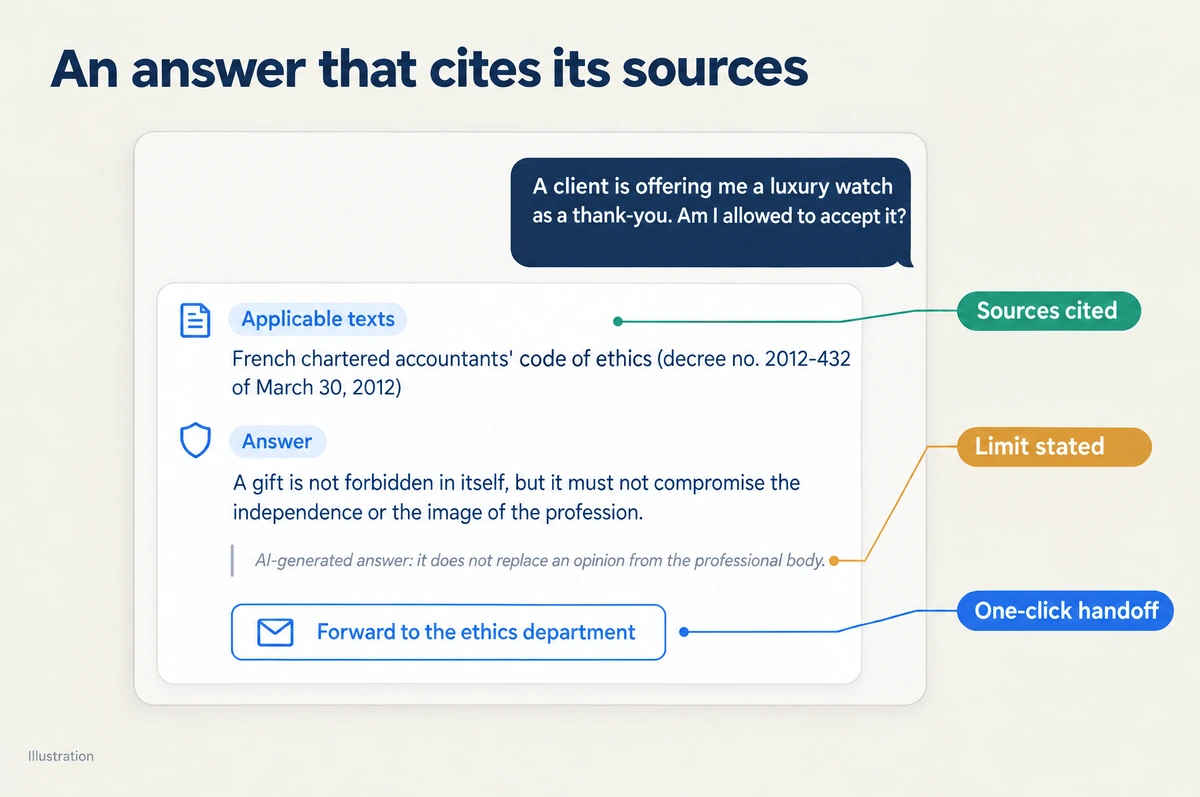
Members and trainees of the Paris Île-de-France Order of Chartered Accountants (the professional organization that regulates accountants in the Paris region) used to send their ethics questions one by one to the Order's team. They now ask an assistant that answers based on the profession's official texts and cites its sources. When those texts aren't enough, it says so and offers to pass the question on to the Order's ethics department.
In service
24/7 a sourced answer, at any hour
- Before
- Ethics questions sent one by one to the Order's team.
- After
- A document assistant with legal guardrails: a sourced answer at any hour, and a handoff to the ethics department when needed.
By the numbers
- June 2026 go-live
- October 21, 2026 certificate of satisfactory performance signed by the Order
- 23 reference documents, 1,266 pages in all
- 806 real, anonymized exchanges with the ethics department
- 188 questions and answers from the Order's FAQ (frequently asked questions)
- 8 routes for sorting each message
How it works for an accountant
- The accountant signs in with their ComptExpert account (the profession's sign-in platform). Their professional status and registration with the Order are checked.
- Access is limited to accountants and trainees practicing in Île-de-France. Users accept the terms of use the first time they sign in.
- They ask their question in everyday language, or describe their situation.
- For a substantive question, the answer always follows the same outline: applicable rules, general principle, conditions or exceptions, application to the case, practical recommendation.
- They can export the exchange as a PDF, or forward it to the ethics department with the address where they want the reply sent.
The knowledge base
- 23 reference documents, 1,266 pages in all: decrees and ministerial orders (including the code of ethics), the Order's internal rules, texts on professional practice, the ethics compendium, practical guides.
- 806 real, anonymized exchanges with the ethics department, and 188 questions and answers from the Order's FAQ (frequently asked questions).
- The documents are split along their structure (chapter, section, article) before being indexed.
- No model has been trained on this content. The assistant searches it for the passages relevant to each question.
How an answer is built
- A first filter, with no AI involved, screens out dangerous requests and sensitive topics, and handles greetings.
- Mistral Small (a language model from the French company Mistral AI) then sorts each message into one of eight routes: document question, conversation, referral to a department, out of scope, danger, sensitive topic, template request, professional standards.
- A substantive question follows the RAG principle (retrieval-augmented generation: answers backed by a document search). It becomes one or two queries, compared with the texts using embeddings (numerical representations of what the texts mean).
- Reranking (re-sorting by relevance) keeps the best passages. Mistral Large writes the answer from those passages alone.
Guardrails
- If the passages found are not relevant enough, the assistant does not answer. It suggests contacting the Order's ethics committee.
- Before anything is displayed, an automatic check compares the answer with the passages. It removes any page numbers, legal references, opinions or facts they do not contain.
- Tax law, employment law, corporate law, liability claims: the assistant recognizes that these are outside its scope and points to the right contact.
- Questions on professional standards get a fixed message that refers them to the ethics department.
- Every document answer states when the base was last updated, and makes clear that it was produced by AI and is not an official opinion of the Order.
Data and hosting
- The application, the document base and the indexes are hosted in the European Union, in Amsterdam, by Railway (a hosting provider: an American company bound by standard contractual clauses).
- Answers are written by Mistral AI. Reranking goes through the European endpoint of ZeroEntropy (a reranking service, an American company).
- A data-processing agreement (article 28 of the GDPR) sets out the roles: the Order is the data controller, Rodium is the processor.
- By default, conversations and inactive accounts are purged after two years, and the activity log after 60 days.
The Order's console
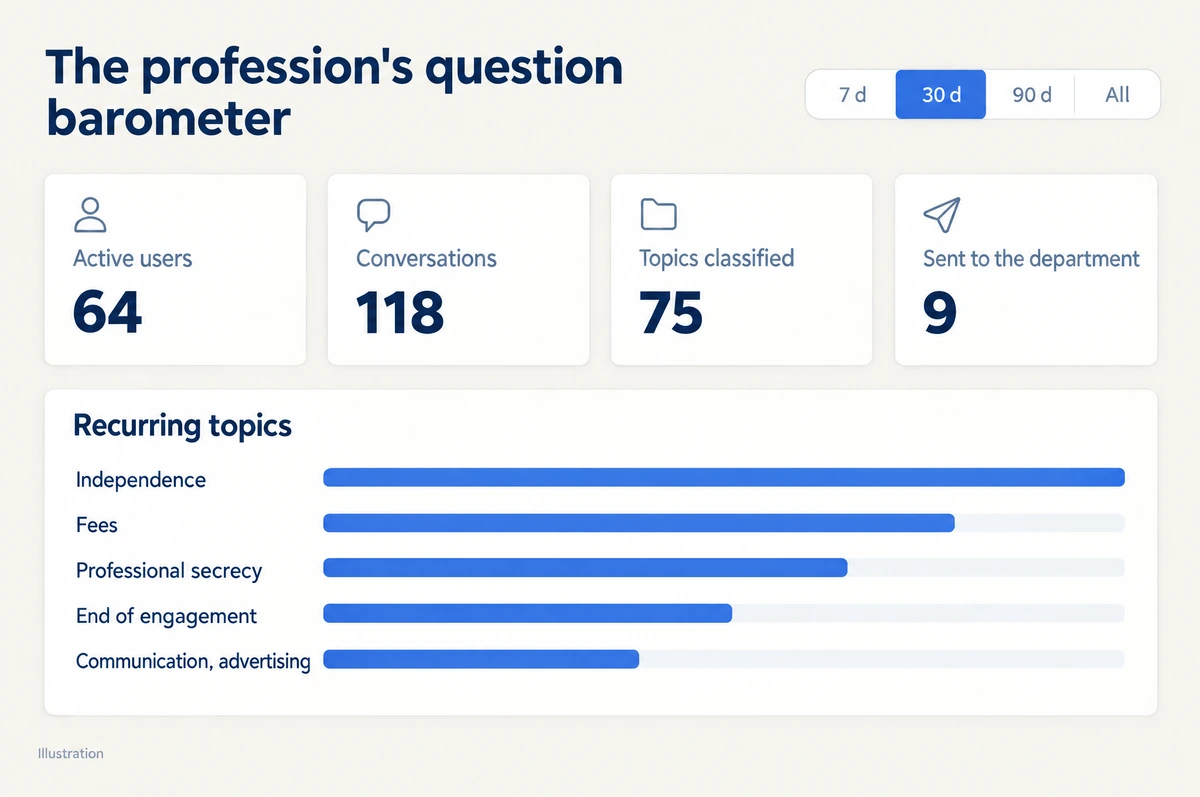
- Administrators track active users, conversations, messages and the exchanges forwarded to departments.
- Each conversation gets a title and one of eleven topics: professional secrecy, fees, independence, end of engagement, and others.
- An activity log records sign-ins, messages and admin actions.
Timeline
- January 2026: the Order commissions the assistant.
- Spring 2026: first test version.
- June 2026: second version, then go-live with ComptExpert sign-in and the console.
- July 2026: public launch, announced by the Order. Rodium then handles maintenance and monitoring.
Technologies
- RAG
- Next.js
- Express
- LangChain
- Mistral AI
- ZeroEntropy
- PostgreSQL
- Railway